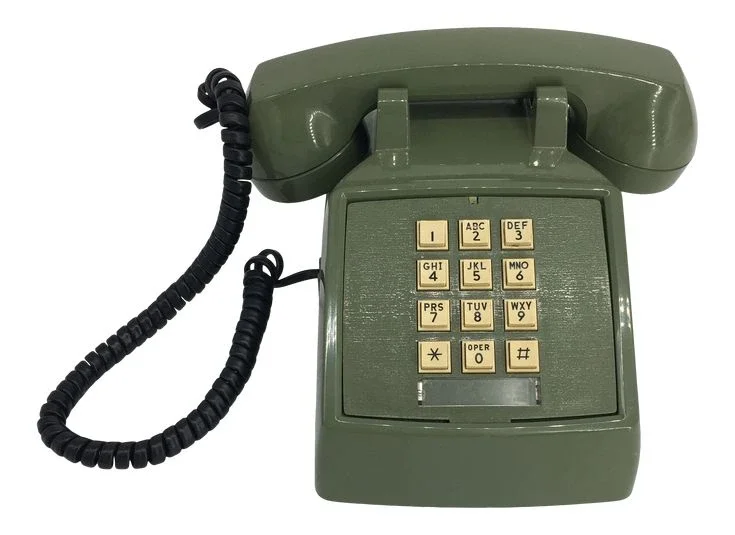

Every month on Quizified, thousands of players take on a fresh set of daily questions. This month, the question that proved hardest was probably a trick for players alive in the 70’s and 80’s and a blind guess for our younger players!
“In November of which decade was touch-tone dialling introduced, eventually replacing rotary dialling?”
Only 10% of players picked the correct answer: the 1960s.
Most guesses clustered around the 1970s or even the 1980s - an understandable instinct if you grew up with push-button phones as standard. But the truth is that touch-tone dialling arrived far earlier than most people realise, quietly setting the foundations for modern telecommunications.
The Correct Answer: The 1960s
Touch-tone dialling was officially introduced in November 1963, placing it firmly in the 1960s. It was rolled out by the Bell System as a faster, more reliable alternative to rotary dial phones.
Instead of sending mechanical pulses by spinning a dial, touch-tone phones used dual-tone multi-frequency (DTMF) signalling. Each key press generated a pair of tones that telephone exchanges could recognise almost instantly. This shift made calls quicker, more accurate, and far more flexible - opening the door to automation and data-driven phone systems.
Why So Many Players Got It Wrong
The confusion isn’t about invention - it’s about adoption.
Rotary phones didn’t disappear overnight. Throughout the late 1960s and well into the 1970s, rotary dialling remained common in homes and offices. Many people’s first memory of a push-button phone comes years after 1963, so the technology gets mentally filed under a later decade.
Quizified questions like this exploit a classic trap: we remember when something became normal, not when it first appeared.
Why Touch-Tone Dialling Mattered
Touch-tone dialling didn’t just make phones more convenient. It changed what phones were capable of.
With tone signalling, networks could support:
Faster call setup and routing
Automated phone services
Voicemail and call centres
Interactive menus (“Press 1 for sales…”)
Without touch-tone dialling, many everyday phone features we take for granted simply wouldn’t exist.
10 Everyday Technologies That Are Older Than You Think
Touch-tone dialling sits in a long tradition of breakthroughs that arrived years—or decades—before people assume. Here are some everyday technologies that routinely catch Quizified players out, each with its real starting point.
Email — 1971
Email as we recognise it dates to 1971, when Ray Tomlinson sent the first networked email over ARPANET and introduced the @ symbol. That’s almost 20 years before the web went mainstream.The Computer Mouse — 1964 (publicly demonstrated in 1968)
Douglas Engelbart’s team built the first mouse in the mid-1960s, with its famous debut during the 1968 “Mother of All Demos.” Many people instinctively place it in the 1980s PC era.ATMs — 1967
The first widely credited modern ATM went into service at Barclays Bank in Enfield, London, in 1967—long before online banking or contactless payments.The First Mobile Phone Call — 1973
Martin Cooper of Motorola made the first handheld mobile phone call in 1973. Consumer adoption lagged by years, which is why many players guess a later decade.Supermarket Barcode Scanning — 1974
The first product scanned with a UPC barcode was a pack of Wrigley’s chewing gum in Ohio in 1974. Barcodes feel like an ’80s innovation, but they arrived earlier.Home Microwave Ovens — 1954
The first home microwave model appeared in 1954, even though most households didn’t adopt them until the 1970s and 1980s.Compact Discs (CDs) — 1982
The first CDs launched in Japan in 1982. For many players, CDs feel firmly 1990s.GPS for Civilian Use — 1995
GPS reached full operational capability for civilian users in 1995, despite being closely associated with smartphones and the 2000s.SMS Text Messaging — 1992
The first SMS message—“Merry Christmas”—was sent in December 1992 over a Vodafone network in the UK.The First Web Page — 1991
The world’s first website went live in 1991 at CERN, years before the late-1990s dot-com boom that dominates popular memory.
Why These Questions Are So Difficult on Quizified
What makes these questions so tough is often misplaced confidence. Our brains compress history around personal experience. We anchor technologies to when they became visible, affordable, or normal, not when they were invented.
Touch-tone dialling feels like a 1970s or 1980s thing. Email feels like it belongs to the web era. GPS feels like it was born with smartphones. And yet, the real dates tell a very different story.
Think you’d spot the next timeline trap? Jump into today’s quiz, join a league, and see whether your instincts can beat history on Quizified.